

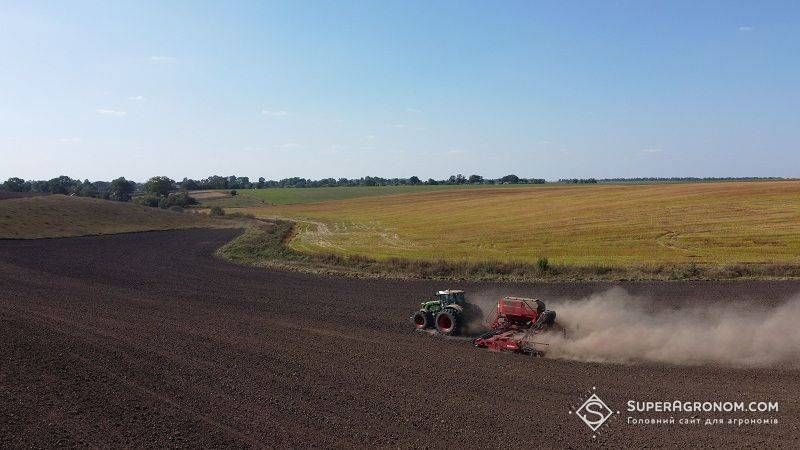
Photo: SuperAgronom.com
The sowing of winter crops has already begun in some places, with farmers using different approaches to starter nutrition. This includes the application of fertilizers before and during sowing. According to Polish specialists, pre-sowing application can be a good decision in certain situations, writes Farmer.pl.
NPK fertilizers are most often applied during pre-sowing soil cultivation or directly in the row during sowing.
“However, in this case, the complex fertilizer mixes with the topsoil. This technology can be effective on fertile soils where the lower layers of the soil profile are rich in phosphorus or potassium. Then, the plant first uses nutrients from mineral fertilizers and then from soil reserves,” the report states.
It is noted that in regions with lower nutrient availability, experts often recommend applying fertilizers deeper, for example, under plowing. In this case, the fertilizers are mixed across a wider cross-section of the soil profile, but their availability to plants is the most important aspect.
“This is most relevant for phosphorus, a nutrient with very low mobility. Potassium is also less mobile, although this nutrient, despite moving through the soil faster than phosphorus, requires significant rainfall and time to penetrate deeper into the soil. Therefore, phosphorus and potassium should be applied deeper,” emphasize the specialists.
This is because if these nutrients are mixed in the topsoil, especially in the case of phosphorus, they will remain there for most of the growing season. Meanwhile, the most branched root network is approximately 20-25 cm (although the root system of cereals extends much deeper). If phosphorus is mixed shallowly in areas with lower nutrient availability, its absorption will be poorer, and soil with low nutrient content will not provide the plant with enough soil-available phosphorus.
Read also: How winter crops will be sown in Ukraine for the 2027 harvest: prices, plans, exports, and loans
The presence of nutrients both in the topsoil and at a depth of 20-30 cm ensures uninterrupted absorption, specialists emphasize. Therefore, in areas with high nutrient content, pre-sowing application of phosphorus and potassium will be most effective. However, in areas with less fertile soil, it is advisable to apply nutrients deeper.
“It is recommended to apply NPK as quickly as possible. This becomes especially important in conditions of intense sunlight and high temperatures, which can be observed even at the end of August or in September. However, it is quite common for fertilizers to be spread ‘in free time’ and sowing to begin only a few days later. If NPK granules remain undissolved on the surface during this time, nitrogen losses are inevitable,” experts claim.
They add that rapid mixing of NPK with the soil protects against nitrogen losses. This applies to any technology, whether applied during soil preparation or during sowing.
Alla Husarova, SuperAgronom.com
Read also: Elixir Group mineral fertilizers: complex NPK, NP, and chlorine-free fertilizers for Ukrainian farmers
Be the first to get the latest agricultural news from Ukraine on our Facebook page, Telegram, and subscribe to SuperAgronom’s Instagram.