

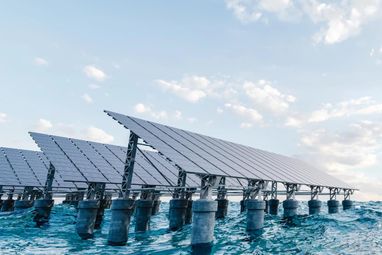
Singapore installed 13,000 solar panels at sea — reasonsIn Singapore, where there is almost no free land left, engineers have built a solar power plant directly at sea — in the Johor Strait near the coast.The construction was designed considering storms, currents, and waves, but the real problem turned out to be marine organisms that began to overgrow the underwater elements of the station.This is reported by The Pulse.Singapore is an island nation with a population of almost six million people, covering an area of about 725 sq. kilometers. There is simply no free space for conventional solar fields, and rooftop panels are insufficient to meet national goals for “green” energy by 2030. Therefore, the energy company EDP APAC decided to build the station directly on the water near the Woodlands district.According to specialists, the marine environment dictates much harsher conditions than freshwater bodies: in addition to the aggressive effect of salt, the system constantly has to contend with waves, tidal fluctuations, and gusty winds. At the design stage, developers focused precisely on these factors, installing a network of tension cables made of durable alloys and anchoring them to the seabed to prevent corrosion and ensure reliable fixation.Read also
Solar panels: what power is needed for a home
According to reports, over 13,000 photovoltaic panels were installed on the water surface, attached to more than 30,000 pontoons. The result is a 5-megawatt power plant, covering about 12 acres of water area and recognized as one of the largest floating solar systems in the world.Researchers also point to a significant bonus of this location: the seawater naturally cools the panels during the hottest hours, so they generate more electricity than land-based counterparts. In addition, the solid layer of panels significantly slows down the evaporation of fresh moisture in the coastal zone.Read also
Do solar panels help during power outages
According to technical data, the complex is equipped with 40 central inverters and one massive transformer, allowing it to produce approximately six million kilowatt-hours of energy annually. At the same time, the Singapore Economic Development Board states that this volume helps reduce carbon emissions into the atmosphere by more than four thousand metric tons annually.Initial tests showed that the platform withstands waves and wind reasonably well. However, dealing with living organisms turned out to be much more difficult.The warm tropical water under the panels effectively turned into a natural incubator. Within a few months, the pontoons and fasteners became overgrown with a thick layer of algae, sea squirts, and thousands of barnacles. According to weighing results, this unwanted mass added almost 43% of excess weight to the engineering structure. As a result, the pontoons began to submerge deeper into the water, and the overall buoyancy of the station dropped sharply.Technical services report that due to the platform’s subsidence, the steel hinges designed to dampen wave oscillations got jammed and stopped moving. With the station sitting lower in the water, salty spray began to flood the electrical connections, threatening corrosion and system failure.Read also
Autonomy: the government has ordered solar panels to be installed in administrative buildings, hospitals, and schools
To save the situation, workers began manually cleaning the buildup from the structures and applying anti-fouling chemicals. Simultaneously, engineers are redesigning the equipment — testing pontoons with an elevated geometry and installing underwater sensors that monitor the weight of the growth in real-time.According to materials: UNIANPlace for your advertisement