

“>
Photo: SuperAgronom.com
On July 1st, a new marketing year commenced in Ukraine. According to the results of the 2025/26 MY, the harvest of grains and legumes increased to 61.04 million tons, but physical export volumes decreased by 7.9%. Latifundist.com analyzed data from the State Statistics Service, USDA, and its own survey of agricultural producers to outline the main trends of the past marketing year.
Based on the results for the year from the State Statistics Service, the total harvest of grains and legumes in Ukraine amounted to 61.04 million tons, which is 8.2% more than in the previous season. It should be noted that the outcome was primarily driven by two main crops — wheat and corn.
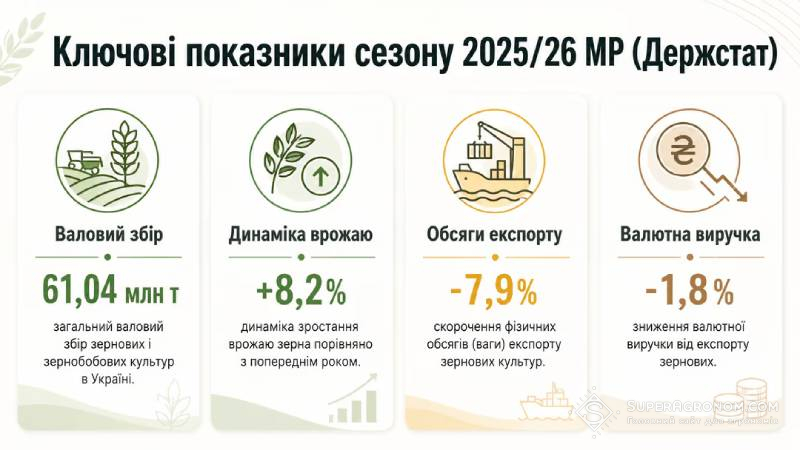
However, the increase in production did not translate into a corresponding increase in shipments to foreign markets, as stated in the material. A portion of the harvested crop remained unsold and was carried over to the new season. These significant carry-over stocks create additional risks: they will put pressure on domestic purchase prices and considerably complicate the sale and logistics of the new harvest.
Regarding weather conditions, 2025 mirrored the trend of recent years: while the West and North gathered high yields, the South, East, and a large part of the Center suffered from prolonged weather anomalies.
Agricultural producers surveyed assessed the season as follows:
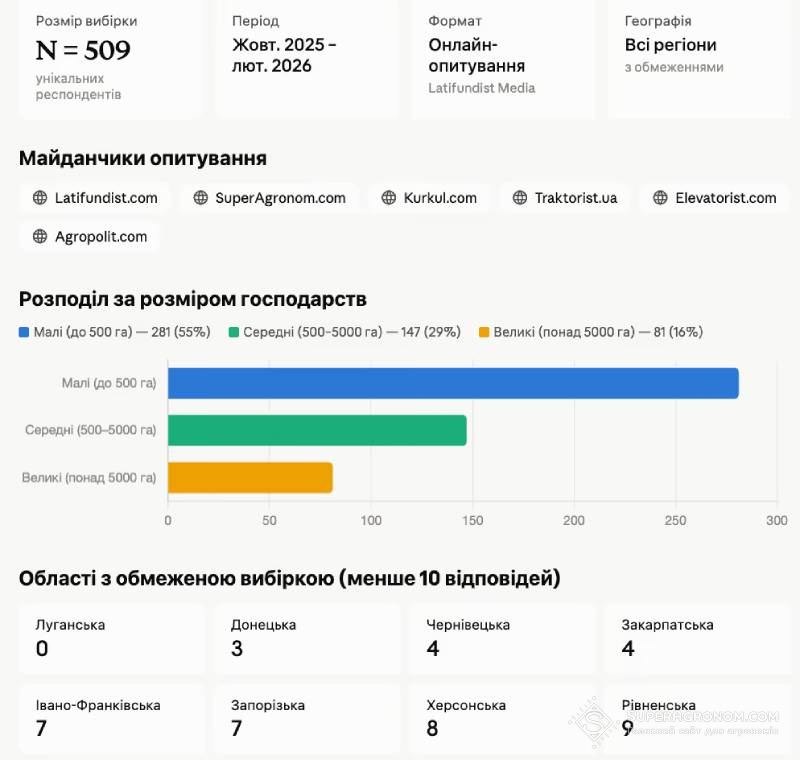
- 56% of respondents out of 509 rated the weather conditions as worse than the long-term average.
- More than half of the surveyed farmers (of whom 498 provided detailed answers regarding moisture supply) reported a catastrophic shortage of soil moisture during the vegetation and ripening of crops.
- The worst assessments of crop condition and moisture supply were recorded in the southern, eastern, and central regions. The most optimistic feedback came from the western and northern regions.
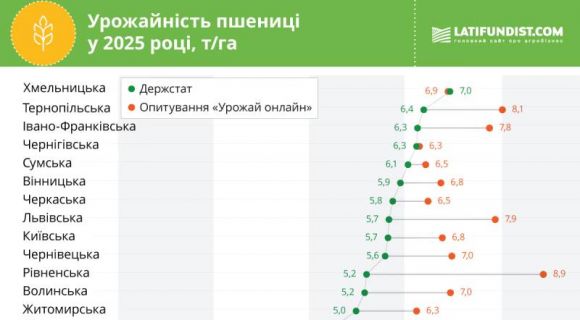
Within the scope of the research, the Latifundist Media team collected actual data from agricultural producers on the yields of main crops in various regions and compared them with official state indicators and USDA estimates. This allows for a more comprehensive view of the season and a comparison of how data from different sources differ.
Overall, the crops finished the season as follows:
- Wheat and barley: yields remain high
- Corn: average yield, but large volume
- Soybeans: production decreased to 4.98 million tons
- Sunflower: the worst harvest since the start of the full-scale war
- Rapeseed: yield decreased to 2.7 t/ha
Wheat showed the best quantitative result since the beginning of the full-scale invasion — 23.34 million tons (+3.6% compared to the previous year). Corn, contrary to concerns, also increased its gross yield to 30.9 million tons (+14.6%). In contrast, the oilseed complex showed a noticeable decline: sunflower harvest dropped to 10.24 million tons (-7%), soybeans — to 4.98 million tons (-25.3%), and rapeseed — to 3.21 million tons (-10.9%).
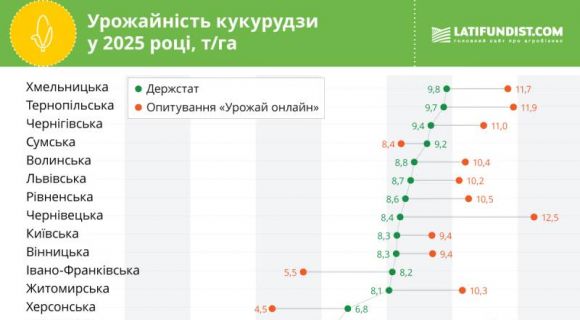
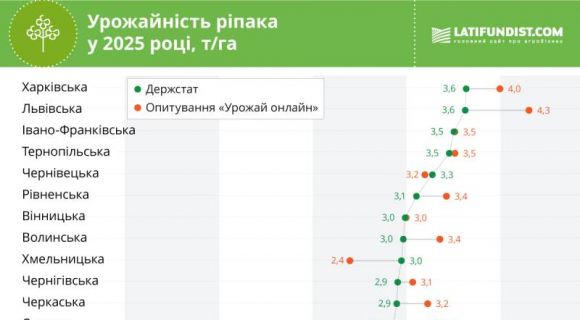
“Production volume is not always equivalent to financial results. The 2025/26 MY proved that market conditions allowed farmers to earn well even on crops with mediocre yields,” the material states.
According to Khrystyna Serebriakova, CEO of the analytical company ASAP Agri and broker at Atria Brokers, the 2025/2026 MY appears very favorable for farmers. Moreover, while corn provided the largest profit last year, this year almost all crops offered producers an opportunity to earn well.
“We observed a sharp increase in prices for wheat and barley at the start, as well as stable profitability for corn and sunflower. Even for rapeseed and soybeans, where producers initially lost margin due to forced sales to processors at reduced prices, the situation later stabilized. However, the new season promises to be fundamentally different and more challenging — due to the pressure of high carry-over grain stocks and optimistic forecasts for the 2026 harvest in the region,” the expert noted.
Alla Husarova, SuperAgronom.com
Be the first to get the latest agronomic news from Ukraine on our Facebook page, Telegram, and subscribe to SuperAgronom’s Instagram.